
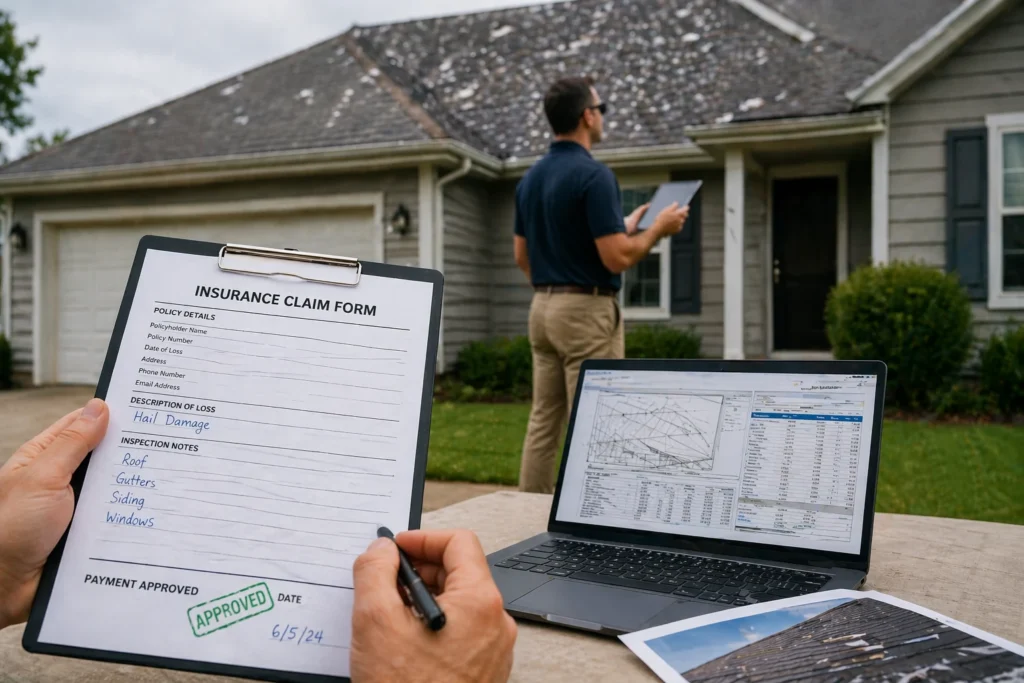
Hail doesn’t knock. It hits fast, loud, and expensive. One minute your roof looks untouched, the next you’re staring at dents, fractures, and a growing sense that something isn’t right. But the real challenge? It’s not the storm. It’s the claim that follows.
And that’s where the question becomes critical: Public Adjuster vs. Insurance Adjuster for Hail Claims in Texas who actually protects your outcome? If you’re a homeowner in Irving, this decision can change everything. Your payout. Your stress level. Your timeline. I’ve seen claims doubled with the right approach and I’ve seen homeowners settle for far less simply because they trusted the process without understanding it. Let’s fix that.
Understanding Hail Damage in Texas
Why Texas Gets Hit So Often
Texas sits in a high-risk weather corridor. Warm, humid air collides with cooler systems, creating unstable conditions that fuel powerful storms. This instability is often explained through convective available potential energy a concept that essentially measures how much energy is available for storm formation. More energy means stronger updrafts. Stronger updrafts mean bigger hail. And bigger hail? Bigger problems.
What Hail Damage Actually Looks Like
Here’s where homeowners get caught off guard. Hail damage is often subtle. No dramatic holes. No immediate leaks. Just quiet deterioration.
Look for:
- Shingles: Bruising, granule loss, soft spots
- Metal roofs: Dents that compromise protective coatings
- Tile roofs: Cracks that spread slowly
- Flashing: Loosened seals or bends
- Gutters: Impact marks that hint at larger issues
The danger isn’t always visible. But it’s there.
Why Claims Are Often Underpaid
This is where things start to shift. Insurance companies rely on efficiency. Quick inspections. Standardized estimates. But speed comes at a cost.
Common issues include:
- Missed components like underlayment
- Minimal measurements
- Labeling storm damage as “wear and tear”
- Ignoring code-required upgrades
And just like that, your claim starts lower than it should.
What Is an Insurance Adjuster?
Their Role
An insurance adjuster represents the insurance company. That’s the foundation.
Their job is to:
- Inspect damage
- Estimate repair costs
- Apply your policy coverage
- Issue a settlement
They’re trained. They’re experienced. But they’re not on your side.
How They Work
The process is structured:
- Schedule inspection
- Perform visual assessment
- Input findings into estimating software
- Generate a scope of loss
- Issue payment
It’s efficient. It’s consistent. But it’s also limited.
The Conflict You Don’t See
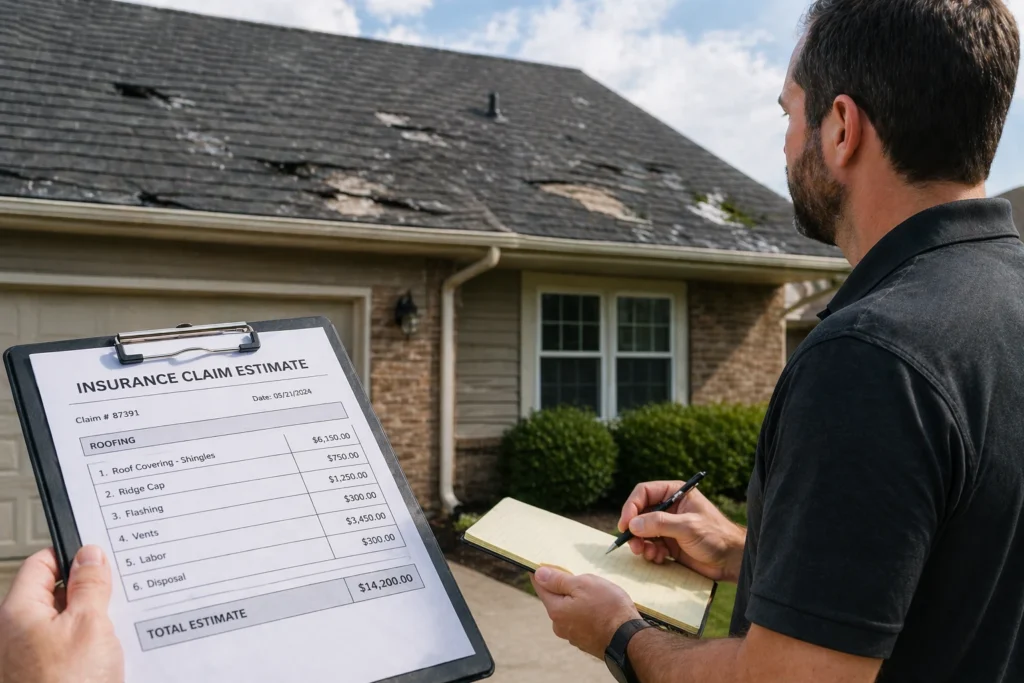
This is where the Public Adjuster vs. Insurance Adjuster for Hail Claims in Texas discussion becomes real. Insurance adjusters must balance accuracy with cost control. And when those two collide? Cost control usually wins.
What Is a Public Adjuster?
A Completely Different Approach
A public adjuster works for you. Period. They are licensed professionals who advocate for the policyholder not the insurer. That changes everything about how your claim is handled.
What They Actually Do
Public adjusters don’t skim. They dig.
They:
- Conduct detailed inspections
- Document every damage point
- Review your policy thoroughly
- Build a complete claim
- Handle negotiations
- File supplements when needed
They don’t accept the first number. They build the right one.
Why Irving Homeowners Turn to Them
In Irving, homes vary. Materials vary. Damage varies. And when claims don’t reflect that complexity, homeowners look for help.
Public adjusters step in when:
- Estimates feel too low
- Damage seems incomplete
- The process becomes overwhelming
That moment happens more often than people expect.
Public Adjuster vs. Insurance Adjuster: Side-by-Side
Let’s keep it simple.
| Feature | Public Adjuster | Insurance Adjuster |
| Represents | Homeowner | Insurance Company |
| Goal | Maximize payout | Minimize payout |
| Inspection | Detailed | Surface-level |
| Payment | % of claim | Salary |
| Negotiation | Ongoing | Limited |
One protects your interests. The other protects the company’s.
The Hail Claim Process—What Really Happens
Without a Public Adjuster
- Claim filed
- Insurance inspection
- Estimate created
- Payment issued
Quick. Clean. Often incomplete.
With a Public Adjuster
- Claim reviewed or filed
- Detailed inspection conducted
- Full scope documented
- Negotiation begins
- Supplements filed
- Final settlement reached
Same process. Different depth.
Where Claims Are Really Won Supplements
This is where most homeowners lose money without realizing it. The initial estimate? It’s just a starting point. The real opportunity lies in refining that estimate through Hail Damage Claim Supplements: What Carriers Miss in Their Scope. This is where precision matters.
Missed items often include:
- Underlayment
- Flashing
- Ventilation systems
- Edge metals
- Code-required upgrades
Public adjusters identify these gaps and build them into the claim. Not inflated. Just accurate.
Real-World Claim Example

Let’s look at numbers.
Without Public Adjuster
- Initial estimate: $14,200
- Missing components: multiple
- Final payout: $14,200
With Public Adjuster
- Initial estimate: $14,200
- Adjusted scope includes full damage
- Supplements filed
- Final payout: $26,900
Comparison Table
| Scenario | Initial Offer | Final Settlement |
| Without Public Adjuster | $14,200 | $14,200 |
| With Public Adjuster | $14,200 | $26,900 |
Same damage. Different outcome.
Why Hail Claims in Texas Require Expertise
Roof Systems Are Complex
Different materials behave differently:
- Asphalt hides damage beneath granules
- Metal shows dents but hides coating failure
- Tile cracks subtly
Each requires a trained evaluation.
Policy Language Matters
Insurance policies aren’t simple documents. Terms like Actual cash value determine how much you’re paid and how much you pay out of pocket. Misunderstanding them can cost you thousands.
Local Conditions in Irving
In Irving, weather exposure and building styles add complexity. No two homes are the same. So why should claims be treated the same?
When Should You Hire a Public Adjuster?
Timing matters.
Best Scenarios
- Large damage
- Denied claims
- Low offers
- Complex roofing systems
Early vs Late
Early involvement:
- Better documentation
- Stronger position
Late involvement:
- Still helpful
- But harder to correct early gaps
If something feels off don’t wait.
Cost vs Value
How They Get Paid
Public adjusters typically work on contingency. No upfront cost. Payment comes from the final settlement.
Is It Worth It?
Let’s be real. If your claim increases by $10,000 and the fee is 10%, you still gain $9,000. That’s not an expense. That’s leverage.
How to Choose the Right Public Adjuster
Not all are equal.
Look For
- Texas license
- Hail claim experience
- Strong documentation process
- Clear communication
Ask Questions
- How do you handle supplements?
- What results have you achieved?
- How often will you update me?
If answers feel vague, move on.
Common Mistakes Homeowners Make
Avoid these:
- Accepting the first offer
- Waiting too long
- Skipping documentation
- Overlooking hidden damage
- Handling complex claims alone
Each one reduces your payout.
Pro Tips to Maximize Your Claim
Simple. Effective.
- Take photos immediately
- Document everything
- Request detailed estimates
- Compare scopes carefully
- Understand your policy
- Don’t rush decisions
And if something feels off it probably is.
Advanced Strategy: Negotiation Matters
Here’s the truth. The first offer is rarely final.
Negotiation strategies include:
- Using accurate estimating codes
- Referencing policy language
- Documenting code requirements
- Maintaining consistent communication
Timing matters too. Early supplements move faster. Late ones face resistance.
Denied Claims What Now?
A denial isn’t the end. It’s a signal.
Steps to take:
- Review denial letter carefully
- Identify gaps in documentation
- Gather additional evidence
- Request reinspection
- Consider professional help
Many denied claims are overturned with stronger evidence.
Final Thoughts
The debate around Public Adjuster vs. Insurance Adjuster for Hail Claims in Texas isn’t just about roles. It’s about results. One works for the insurance company. The other works for you.
In Irving, where hail damage is common and often underestimated, that difference matters. Your claim isn’t just paperwork. It’s your home. Your investment. Your peace of mind. Don’t leave it to chance.
FAQs
A public adjuster works for you, while an insurance adjuster works for the insurance company to evaluate and process your claim.
Yes, especially for larger or complex claims, as they often help increase the final payout significantly.
Yes, you can bring in a public adjuster at almost any stage, even after receiving an initial estimate.
They can, especially subtle or hidden damage that requires more detailed inspection and documentation.
Most work on a contingency fee, meaning they take a percentage of the final settlement with no upfront cost.
Not necessarily while it may add steps, it often leads to a more accurate and higher settlement.
You can request a reinspection, provide additional documentation, or hire a public adjuster to challenge the decision.
It varies, but most claims take a few weeks to a few months depending on complexity and negotiations.
Document everything with photos, prevent further damage, and file your claim as soon as possible.
It depends on the claim, but many homeowners see significantly higher payouts after professional representation.